Shopify market-driven shipping: the 1 October rollout and what to check
Shopify’s shipping rollout starts on 1 October 2026. Check app compatibility and checkout rates before moving shipping options into Markets.
 Will Slatton3 min read
Shopify’s market-driven shipping rollout begins on 1 October 2026, when merchant opt-in opens. The change moves merchant-managed shipping options into Markets, bringing destination and delivery configuration together. Shopify’s published timetable runs through 1 July 2027; 1 October is the beginning of the transition, not a deadline requiring every existing store to migrate overnight.
For merchants preparing holiday shipping, the immediate task is to check how their shipping apps will handle the change before opting in. Shopify sets out the dates and compatibility requirements in its fulfilment rollout announcement.
Update, 1 October 2026: Shopify’s published schedule sets today as the opening of merchant opt-in and automatic opt-in for new shops. Existing merchants move across during the transition as their apps become compatible. Check your own admin and app readiness before switching; this is the announced timetable, not a test of rollout completion on every store.
What changes in the shipping setup
Instead of starting with a delivery profile and its shipping zones, merchants attach shipping options to a market. Within an option, rates can vary by product collection and fulfilment location. Shopify’s feature documentation shows how this changes the admin interface.
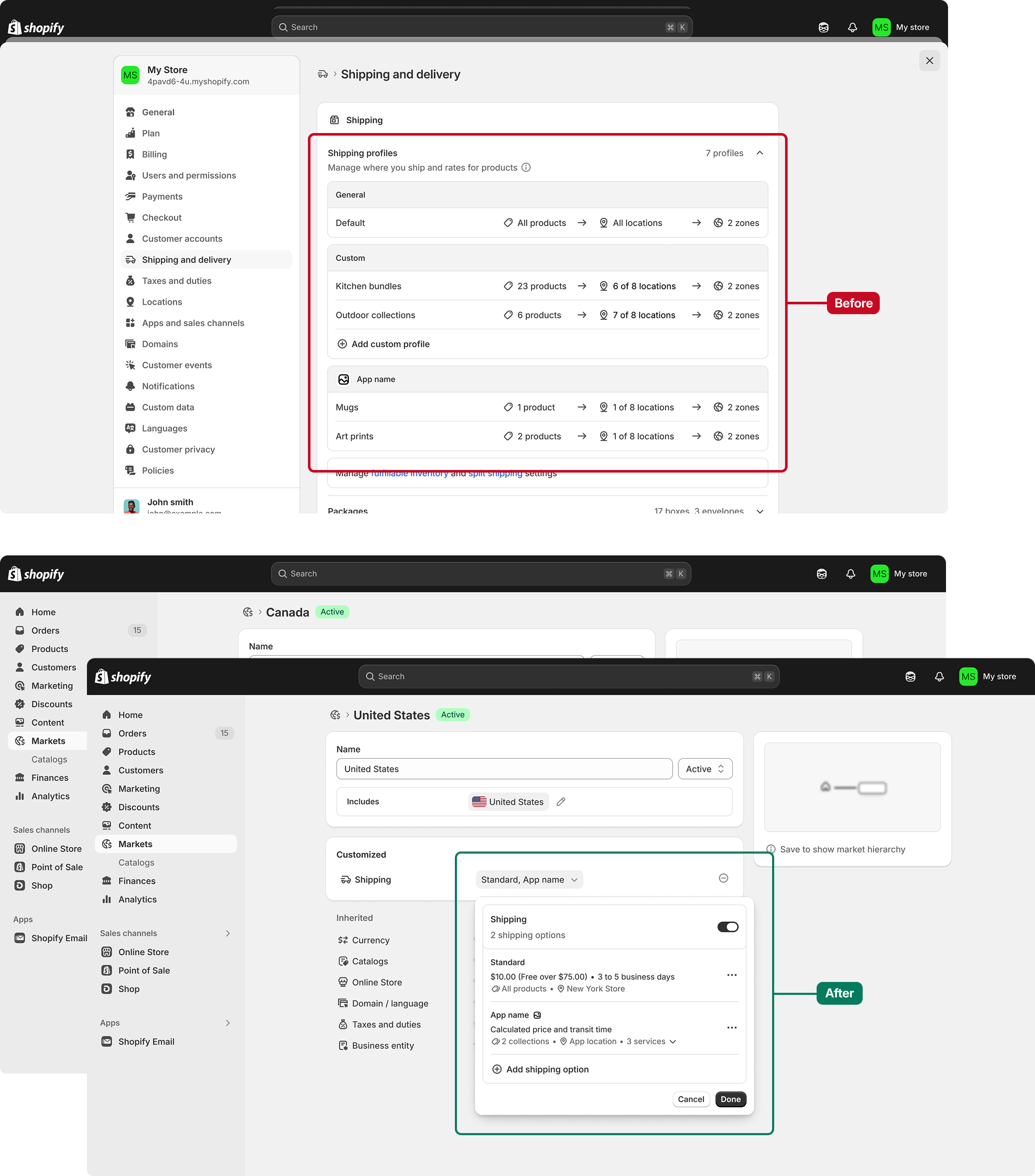
The way rates combine also matters. When multiple conditions match within the same shipping option, Shopify can use the highest matching rate rather than adding the rates together. That makes mixed-product and multi-location baskets particularly useful test cases. It does not mean every shipping charge automatically falls.
Ask app providers which configuration they manage
Shopify’s developer announcement distinguishes merchant-owned configuration from app-owned delivery profiles. Apps that read or change merchant shipping settings through the delivery profile API need to adapt to the Markets API. App-owned profiles continue using the delivery profile API, and app-provided rates remain part of the new experience.
Shopify also says incompatible apps can show warnings on new installs from 1 October. A familiar app name alone is therefore not confirmation that a store’s particular workflow is ready.
A practical pre-switch checklist
Our recommendation is to make the migration a controlled checkout test:
- List the apps and custom integrations that read or change shipping settings, and ask their maintainers to confirm compatibility.
- Record the expected charge for representative baskets before changing configuration: one product, mixed collections, multiple fulfilment locations and different destination markets.
- Repeat those baskets after the change, including free-shipping thresholds and any carrier-calculated options your store uses.
- Give support and operations staff the confirmed delivery options and prices so customer answers match checkout.
The documentation labels the rollout timetable as subject to change. Check Shopify’s current guidance and your own admin before scheduling a switch. Treat the opening of opt-in as a prompt to verify readiness, rather than a reason to make untested shipping changes just before peak trading.
15 October update: check ship-and-pickup availability separately
Ship and pickup in one order is a separate capability from market-driven shipping. Shopify’s June announcement introduced a feature test drive for Plus and Enterprise organisations. It lets shoppers send some items home and collect others in the same checkout.
The published roadmap lists 12 October 2026 for expanded Cart API support, including pickup locations with only some items available. However, when checked on 15 October, the merchant Help page still says product and cart pages cannot choose delivery methods per item before checkout. These descriptions are not aligned. We have not verified the expanded behaviour on a merchant store, so the scheduled date should not be treated as confirmation that it is available in your storefront.
The documented checkout test drive requires Plus or Enterprise, supports one pickup location per order and excludes local delivery and pickup points. Before enabling it, check that your fulfilment integration keeps pickup items out of shipping queues, and that confirmation emails explain both parts of the order. This is also distinct from POS local delivery: all physical items in that order must be delivered, rather than mixed with shipping or pickup.
More from News
See all →