Barn2’s Shopify app revenue estimates: read the limits
Barn2 estimates concentrated revenue in a sample of Shopify apps. The assumptions and exclusions matter before using those numbers.
Barn2 founder Katie Keith’s 19 October analysis of Shopify apps estimates that 16 apps account for 40.6% of revenue in a sample of 1,675 priced, detectable apps. That is a finding about a modelled sample, not an audited revenue split for the entire Shopify App Store.
The distinction matters for founders deciding whether to build an app, acquire one or change positioning. A concentration estimate can inform a research question; it cannot establish what a particular business is worth.
What went into the estimate
Keith combined public listings, prices and Store Leads detections with assumptions about paid-plan adoption calibrated against roughly a dozen apps with known financial data. Apps without sufficient detection or pricing information were excluded. The model puts the sample’s median monthly revenue at $2,500–$5,200 before Shopify’s cut.
App age was the strongest revenue predictor in the analysis. That association does not demonstrate that age itself causes revenue growth, or that a newer app cannot succeed.
Questions to ask before acting on the headline
Our editorial takeaway is to investigate the category and the business separately. For a category, map the leading listings, their positioning and the merchant problem you would solve differently. For an acquisition, reconcile reported revenue with billing records, refunds and customer cohorts rather than using a marketplace-wide estimate as a valuation shortcut.
Ask how much revenue comes from newly paying merchants, how existing cohorts retain revenue, and how free users convert. Request consistent monthly periods so that a strong recent month cannot conceal a weaker longer-term trend.
Keith also sells Shopify apps and describes Barn2’s own launch experience. That makes the article a useful founder perspective, with a commercial context readers should keep in view.
4 November: Shopify adds a different signal—install growth by tag
A 3 November chart from Shopify Developers reports the five leading App Store tags by install growth in Q3 compared with Q2 2026, excluding reinstalls: Product content, 47.3%; Payments - other, 31.6%; Product feeds, 28.1%; Operations - other, 28.1%; and Advertising - other, 27.4%.
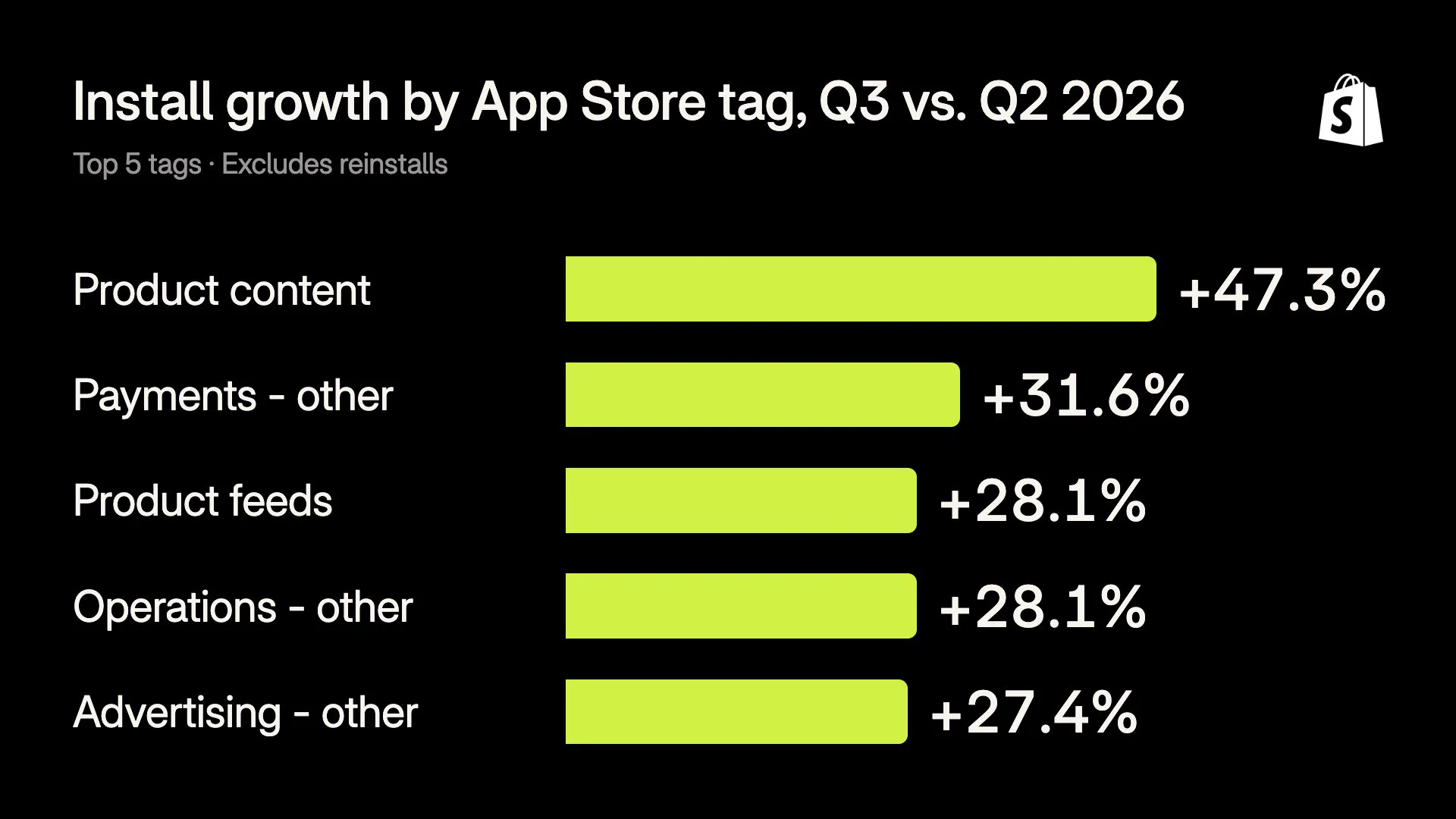
This is Shopify’s own install-growth snapshot, separate from Barn2’s revenue estimates and other third-party app censuses. The chart does not provide absolute install totals or retention. A fast-growing tag is therefore a useful research lead, not proof of a large market, profitable apps or a particular Sidekick recommendation threshold.
Our recommendation for builders is to investigate the merchant problem behind a tag, then validate willingness to pay and retention independently. Do not convert percentage install growth into an estimated revenue opportunity without those missing inputs.
16 November: review counts are a separate measure
A separate October analysis by Taylor Sicard provides a useful comparison without measuring revenue. Sicard reports randomly selecting 400 URLs from Shopify’s English App Store sitemap, then reading their launch dates and review counts on 28 October. Within that sample, 77% of the apps launched in 2026 had no reviews, as did 68% of the 2025 cohort.
Those percentages describe launch-year subsets of 400 listings, not 400 apps in each year. Sicard cautions that cohorts below 30 apps are noisy. The observations also precede Shopify’s 29 October mass-submission cleanup, so they are not a current census.
Keep the measures separate: reviews, installs and modelled revenue answer different questions. No reviews does not prove no paying customers, and many reviews do not establish profit. For an app you are considering buying or building against, investigate merchant retention and billing evidence directly rather than converting a review count into a revenue estimate.
More from News
See all →


